

AI Coding Landscape: How Agents Disrupt Software Engineering?
From copilots to task engines: how AI is redefining who builds software and how it gets built.

Key Takeaways
The landscape of AI coding is being shaped by two powerful, reinforcing trends:
LLMs as Expanding Reasoning Engines:
Each new generation of LLM — moving from Sonnet 3.5 to RL paradigms like O1 Pro — has consistently improved at coding and reasoning. Coding is inherently more structured than natural language, and automated runtime verification closes the loop. This makes the leap in AI capabilities directly translatable into product experience.
Broader User Access and the Rise of Citizen Developers:
While roughly 50 million people worldwide currently identify as developers, the pool of “knowledge workers” who could benefit from software creation is an order of magnitude larger. In many cases, these individuals don’t need to write code; they just need outcomes. AI-generated “task engines” now empower anyone—from professional engineers to non-technical operators—to spin up disposable, hyper-personalized applications. This democratization will enlarge the total addressable market well beyond traditional dev tools.
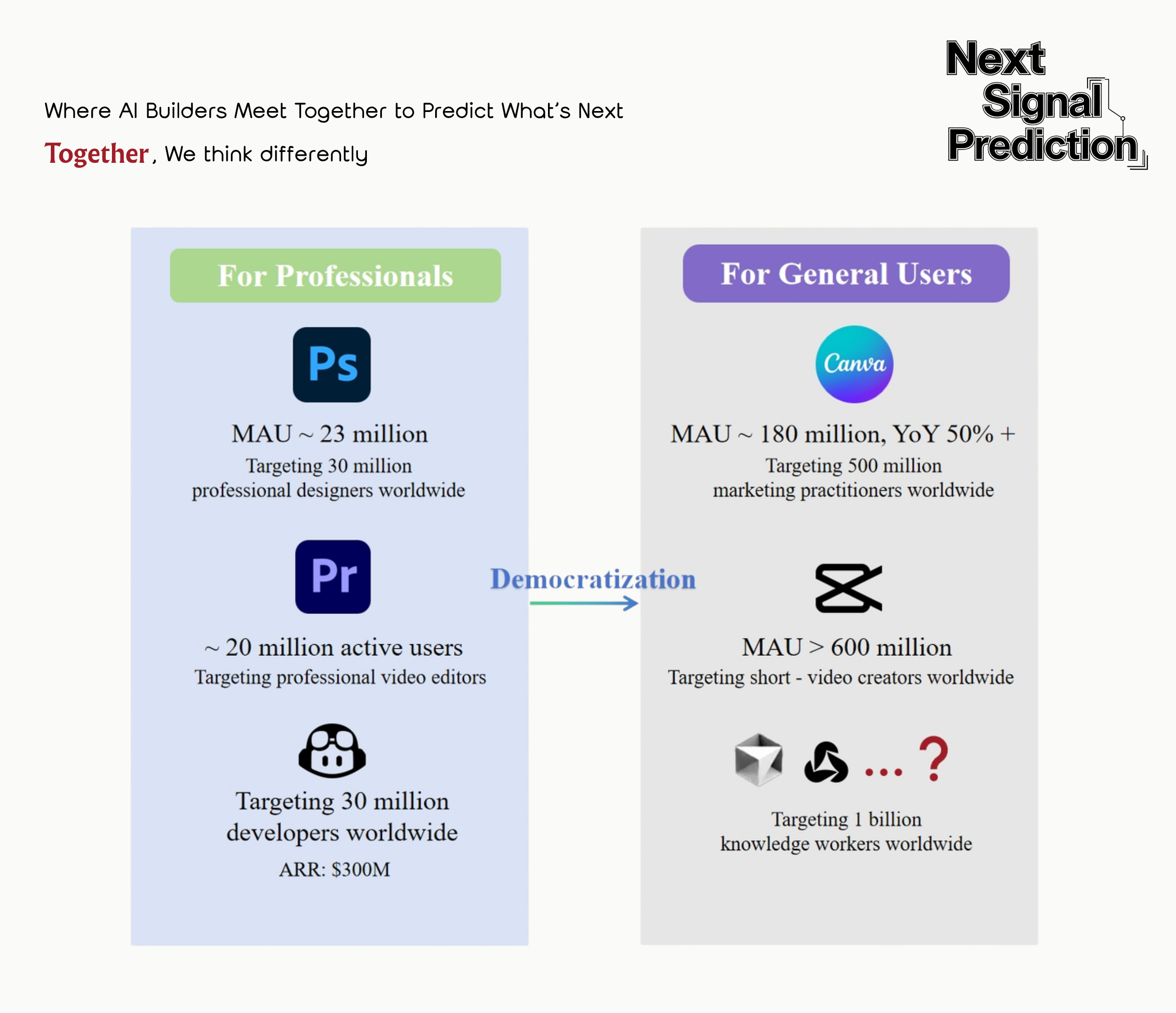
This research provides a panoramic view of the AI coding domain and its key players. We see a bifurcation in the market: one set of companies focuses on professional developers operating in complex, large-scale codebases; another set targets “citizen developers” looking for individual, custom workflows.
For professional engineers, AI is moving from a mere copilot — like GitHub Copilot — toward fully agentic capabilities that handle end-to-end coding tasks. Early copilots such as Cursor and Windsurf excel at supercharging indie developers’ productivity, speeding up code generation, test creation, and refactoring. However, unlocking the full potential of autonomous agents in enterprise environments is more complex. Enterprises must tackle large, unwieldy codebases, legacy systems, intricate compliance mandates, and complex integration workflows. While small teams and indie developers readily embrace agent-driven coding, large organizations will embrace these solutions more cautiously and incrementally. Thus, we believe copilots and agents will coexist for a long time.
On the other side of the spectrum, the emerging category of “task engines” promises to deliver software solutions to non-developers—on-demand, contextually aware, and disposable. Instead of building a massive app for millions of DAUs, a task engine creates a purpose-built experience for one user, one workflow, one moment in time. This vision mirrors the historical shift from command lines to GUIs in the PC era. We expect a similar UX revolution as intuitive front-end interfaces for AI coding emerge. Those who successfully deliver a fluid, GUI-like interaction paradigm will capture enormous upside as they unlock software creation for millions who never wrote a line of code.
Landscape mapping
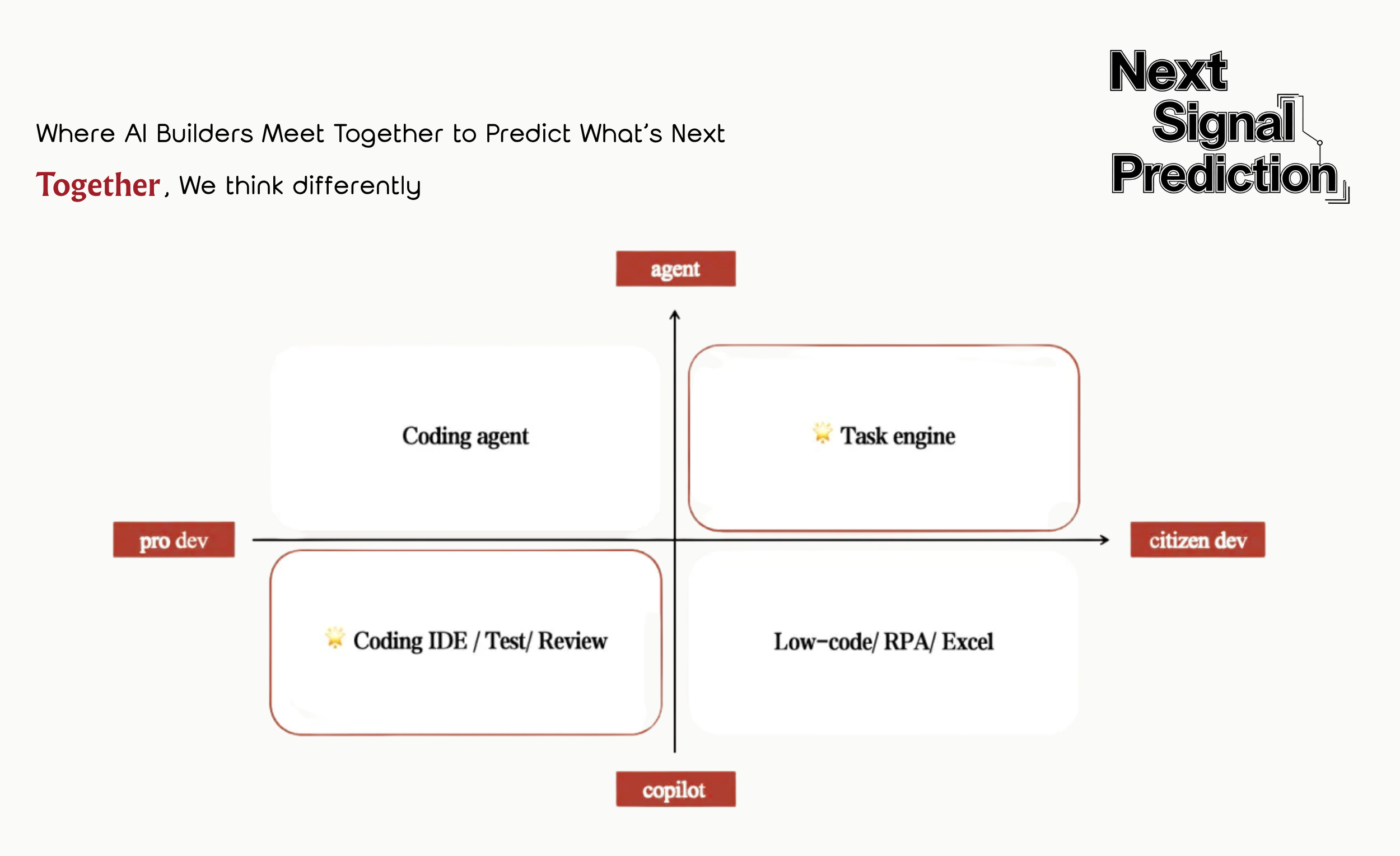
We categorize AI coding products along two dimensions: the level of autonomy (Y-axis) and the target user capability (X-axis).
Y-axis: Degree of end-to-end completion. Products higher up can take a spec and deliver a solution with minimal human oversight.
X-axis: Target user capability. To the left, solutions cater to professional developers; to the right, they serve users with little to no coding background.
Key Segments:
Copilot for Pro Developers
These products—like Cursor and Codeium—embed seamlessly into existing developer workflows (e.g., IDEs, VS Code) and prioritize immediate productivity gains. They’ve succeeded because they respect developer habits and deliver value incrementally. Cursor’s staggering ARR growth (reportedly $65M with 300,000 paying users) underscores the fervor in this space. Yet scaling beyond the “indie hacker” demographic is the open question: can these solutions penetrate the broader enterprise segment, like Canva going from individual designer to enterprise designers?
Agent for Pro Developers
Here, we see companies attacking more ambitious enterprise challenges: codebase comprehension, compliance, context management, and long-horizon reasoning. The holy grail is an AI engineer that can handle complex tasks end-to-end. While we’re still early, the payoffs could be enormous: enterprises will pay a premium for automation that reduces toil and accelerates development lifecycles. However, with well-funded competitors, differentiation will hinge on how well these agents handle real-world complexity, compliance, and performance at scale.
Agent for Citizen Developers
This emerging category offers a radical proposition: democratize the creation of disposable, personalized software artifacts. Products like wordware, Websim and Replit Agent represent an early glimpse of the future. Today, these tools feel reminiscent of the command-line era—useful but unintuitive for the masses. The company that pioneers a breakthrough “GUI moment” in AI coding will open the floodgates for a vast, underserved audience. The immediate upside might be modest, but the long-term potential is vast, with these platforms potentially becoming the “Google of AI-driven software generation.”
Copilot for Citizen Developers
Low-code and RPA have existed for years, and while AI can bolster these tools, the market isn’t as novel or disruptive compared to the three segments above. Many legacy players may adapt AI to stay competitive, but this space isn’t where we see the most transformative opportunity.
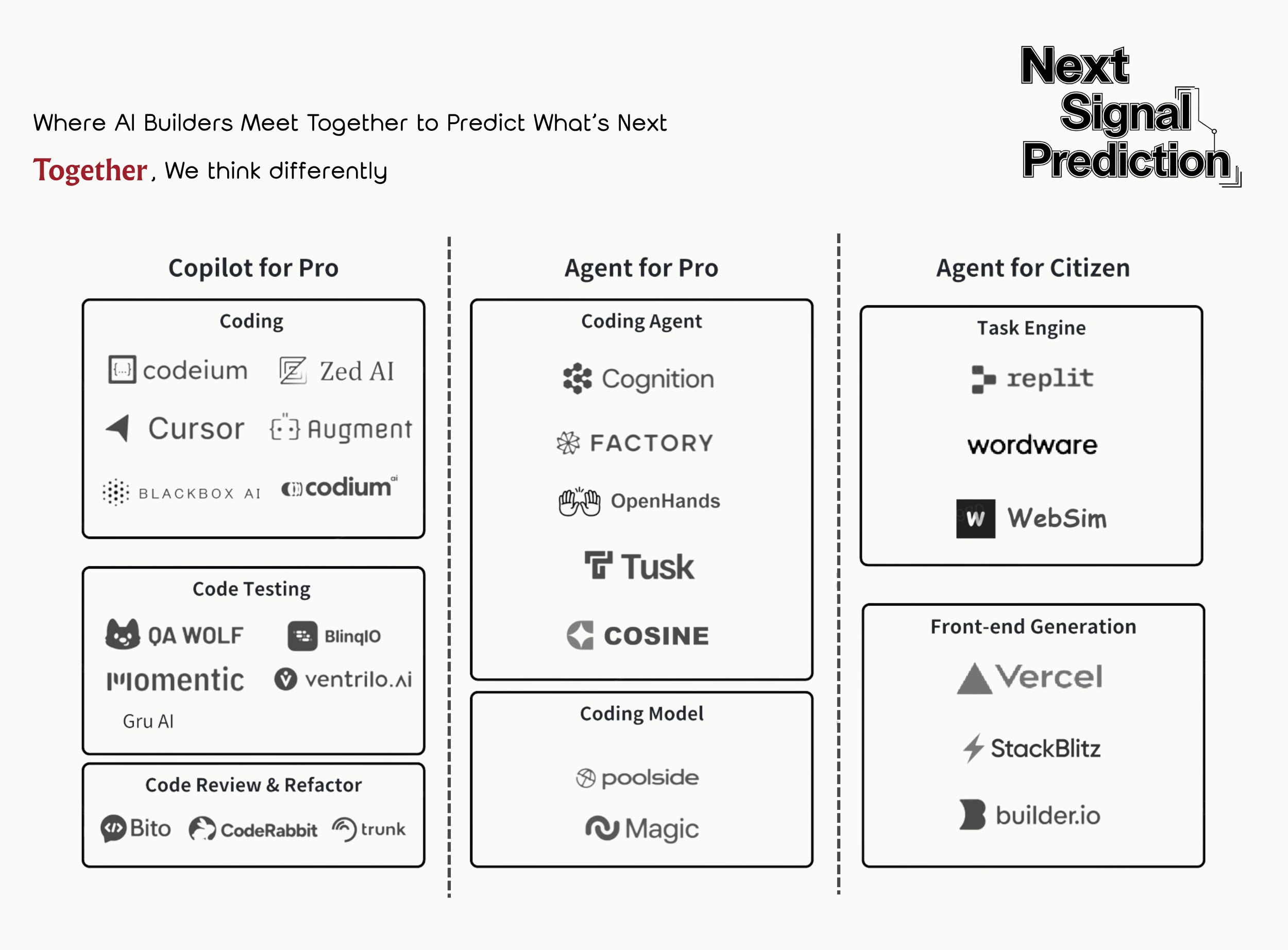
Based on our analysis, we add relavant companies around the space into the mapping below:
Based on our analysis, we add relavant companies around the space into the mapping below:
Copilot for Professionals
In the coding space for pro developers, two product strategies predominate: building integrated development environments (IDEs) vs. developing lightweight VSCode extensions. Each approach has distinct trade-offs. A custom IDE offers full product freedom—enabling richer data collection, feature control, and a more robust user experience—while a VSCode extension lowers user switching costs and achieves rapid adoption. The optimal solution might combine both.
Case study: Cursor’s PLG Approach
Cursor’s strategy is especially deft. By forking VSCode, they’ve secured the agility and user familiarity of the existing extension ecosystem while also gaining deeper control over the IDE environment. This hybrid approach enables them to rapidly iterate on features, mine user data for insights, and develop advanced capabilities that a standard extension simply cannot achieve.
Cursor excels at delivering a “fast and fun” experience. They focus on “next-action prediction,” so a developer’s workflow becomes a smooth experience: pressing Tab yields immediate, relevant suggestions, creating a flow state that keeps users engaged. Their recent acquisition of Supermaven underscores their priority on speed. While asynchronous, agent-driven interactions (like the O1 paradigm) are on their roadmap, their near-term emphasis is on synchronous, human-in-the-loop coding that’s both delightful and hyper-productive.
Cursor has achieved an ARR of $65M with around 300,000 paying users according to Sacra latest report. Their growth speed is incredible as their projected ARR is ~$4M in early 2024:
2023/10: $1M
2024/04: $4M
2024/07: $14M
2024/10: $48M
Cursor’s success highlights the importance of developer delight and rapid product cycles. But the long-term ceiling for Cursor hinges on the size and growth of the indie developer market. If indie hackers scale to 5 million globally (around 10% of all developers), Cursor could tap into a billion-dollar opportunity. If not, they risk plateauing.
Cursor emphasizes speed and next-action prediction for iterative development, while Codeium focuses on automation and enterprise needs like on-premise deployment and compliance.
Case Study: Codeium’s enterprise-infra-native approach
Codeium started with a VSCode extension, but their move toward an IDE product, Windsurf, suggests a strategic pivot toward owning the entire developer environment. Unlike Cursor’s emphasis on “flow” and immediate next-step suggestions, Codeium invests heavily in automation and chat integration with workflow. Their users can accomplish basic development tasks without much hands-on coding, thanks to a more comprehensive conversational layer. This differentiation displays their focus on enterprise demands.
Significantly, Codeium’s worldview is more enterprise-focused. While Cursor has thrived among indie developers, Codeium has set its sights on enterprise customers who demand compliance, security, and customization. They offer on-prem deployment, strict adherence to regulatory frameworks, and enterprise infra-native features like containerized deployments, role-based access control, and rigorous data provenance. This heavy enterprise tilt is a clear strategic differentiator.
Codeium excels in enterprise go-to-market (GTM) strategies by addressing key corporate concerns:
Security: Support for deployment options like self-hosting and containerized solutions (e.g., Docker, Kubernetes) to ensure data isolation.
Compliance: Proving training data does not include copyrighted or unlicensed material and ensuring traceable, cleaned data sources.
Personalization: Leveraging high-quality, relevant data for fine-tuning and access control (RBAC) to prevent data leaks.
ROI Analysis: Offering tools to track team-level usage and effectiveness to demonstrate AI’s value.
Scalability: Efficiently handling large codebases and complex enterprise environments with robust indexing and latency management.
Enterprise markets seem “low-hanging fruit” due to clearer needs but face fierce competition from GitHub Copilot, which benefits from strong distribution channels. Startups should differentiate by addressing areas GitHub struggles with.
R&D-Driven Product Differentiation
These coding copilots are not mere “apps”; they’re research-driven product labs. Cursor calls itself an “applied research lab,” while Codeium and Augment publish deep technical blog posts on fine-tuning, retrieval-augmented generation (RAG), and specialized enterprise deployments. Their innovation cycles resemble a frontier R&D effort more than a standard SaaS product roadmap.
Codeium & Augment: They focus on proprietary retrieval methods for massive, fragmented enterprise codebases, deploying specialized embedding models and advanced RAG techniques. Complex enterprise contexts demand a new generation of embeddings and indexing solutions. Codeium’s ability to run fully on-premise coding models makes it especially appealing for large customers where data never leaves the firewall.
Cursor’s Future Research: Cursor envisions asynchronous, agent-driven coding workflows via “shadow workspaces.” This involves creating a sandbox where a coding agent iterates on solutions, interacts with LSP protocols, responds to lint feedback, and refines code autonomously—without messing with the user’s original files. Here, Cursor’s research on reasoning frameworks resonates with O1 inference-time compute paradigms.
Augment:
Testing: AI-Enhanced QA, Unit Tests, and UI Verification
Coding workflows include coding, testing, code review and refactoring. Products like Cursor and Codeium focus on IDEs and VS Code extensions, balancing ease of adoption and control over user behavior.
Testing—both unit tests and end-to-end UI checks—is an integral yet often reviled part of the developer workflow. The repetitive, rules-based nature of writing tests aligns perfectly with AI’s strengths. Developers rarely enjoy writing tests, as indicated by low coverage rates in many teams, so there’s a natural opportunity for automation.
Some startups in testing predate the current LLM boom, like QA Wolf, which used rule-based approaches to achieve wide test coverage. Now, AI-first approaches are emerging. Momentic (YC, AI Grant) focuses on human-AI collaboration for UI testing, while Gru AI targets enterprise unit testing with dedicated agents. The sheer unpleasantness of test writing for human developers represents a wide-open field for AI players to command strong adoption.
Code Review & Refactoring: Towards Fully Automated Quality Assurance
Code review and refactoring are time sinks and quality gatekeepers. They matter for everyone, from indie hackers pushing small PRs to Fortune 500 enterprises maintaining sprawling codebases. According to TechCrunch, 50% of enterprise developers spend about 5 hours per week on code reviews. Tools like CodeRabbit, which reportedly reached $100M+ ARR in under a year and processed over 3 million PR reviews, showcase that LLM-native solutions can deliver immediate ROI today.
Refactoring—optimizing code and reducing technical debt—also lends itself well to autonomous or semi-autonomous solutions. Code migration tasks, which historically required human attention to detail and domain knowledge, can now be tackled by coding agents with strong context reasoning abilities. This is where coding agents will likely achieve early product-market fit: performing the tedious “1 to 100” tasks that developers dread, not just the “0 to 1” creative leaps.
Agent for Professional Developers
The biggest bets—and the heaviest funding rounds—are on coding agents that promise full end-to-end automation of the development lifecycle. Companies in this space are divided into Coding Agents, which build workflows on top of existing LLMs, and Coding Models, which develop specialized coding-specific models from scratch. The latter is less favored due to competition with major LLM providers like OpenAI.
Yet the challenges are immense:
Technical Hurdles:
Large enterprise codebases require extended reasoning and long-horizon planning. Agents must ingest extensive context, understand intertwined dependencies, and break tasks into logical steps. True autonomy demands a level of comprehension that current LLMs only approximate.
A company have a lot of engineering and business context. Large codebases are difficult to navigate, and legacy projects often lack continuity when engineers leave. Although AI can theoretically process longer contexts, its comprehension and search accuracy are not yet sufficient.
UX and Workflow Integration:
Perfect autonomy doesn’t exist yet. As a result, these agents need to seamlessly involve human oversight. Models must know when to ask for help, what clarifications they need, and how to adapt if a chosen path hits a dead end.
For now, coding agents find their strongest foothold in toil-laden tasks like code migration and large-scale refactoring—scenarios where human engineers are delighted to offload grunt work. Over the next two years, as LLM reasoning and agent frameworks advance, coding agents will likely assume more significant roles. The pricing model for these agents will also evolve: unlike seat-based dev tools, consumption-based pricing that scales with tasks completed may be more appropriate—and easily justified.
Agent for Citizen Developers
We envision a future where anyone can request software—no coding needed—through a “task engine” paradigm. Like search engines that retrieve web pages, task engines produce ephemeral software tailored to a user’s specific needs. Coding skill is no longer the barrier; users only need to articulate what they want. Once GUIs replace today’s clunky, command-line-like AI interfaces, the gates swing wide open for mass adoption.
Replit Agent: Works like a cloud IDE, providing iterative, chat-based development steps. It mimics a conversation between a PM and an engineer, gradually refining requirements and features. This approach demands users think through their needs more concretely—alignment through dialogue.
Wordware: Positions itself as a “Notion for LLM apps.” It cleverly grew via a Twitter-based viral loop. However, sustaining that growth requires evolving beyond a niche novelty. Its early traction resembles how Perplexity gained attention last year, but maintaining user engagement beyond the initial buzz is a core challenge.
Websim: Offers a rudimentary browser-like environment where users can create and consume web apps simultaneously. With a template-based, Canva-like experience, users can modify and evolve their creations easily. It’s early days, and the product still needs refinement, but the combinational nature—websites generating more websites—hints at a rich innovation space.
Frontend Generation Startups: Vercel (V0), Stackblitz (bolt.new), create.xyz also show promising progress in automated web app creation. Their demos improve weekly, producing near-production-ready frontends from a single prompt. But these demos often run into scaling and maintenance issues—fine for disposable apps, but not yet ready for long-term, stable use cases. Historically, front-end democratization stories produced giants like WordPress and Shopify. The question now: can AI-native frontend generation unlock incremental or wholly new demand, ultimately expanding the entire market?
Open questions
Software Engineering, Not Just Coding, Will Be Democratized: As AI reduces the friction and cost of software creation, we won’t see everyone become a “coder” per se. Instead, we’ll see the democratization of software engineering outcomes. Users will behave more like product managers—thinking at a higher level about what they want built, rather than how to build it. The endgame is a world where the logic of software is accessible without traditional programming knowledge.
UI/UX and the Imminent GUI Moment: Today’s AI coding tools feel like command-line interfaces: powerful, but obscure to the uninitiated. The real inflection point will come with GUI-level product innovation—making these capabilities intuitive and painless for a broad audience. Beyond synchronous code generation scenarios, asynchronous “O1”-style computations will let agents tackle complex tasks offline and return polished results to users. This hybrid synchronous-asynchronous model—spanning immediate feedback loops and background computation—will define the next wave of AI-driven development experiences.
Just as the GUI unleashed a generation of PC users, the right interaction paradigm will unlock the full potential of AI coding for everyone. It’s a moment the entire industry is racing toward, and we believe coding-focused AI products will serve as the proving ground for these transformative user experiences.